
TL;DR
Reseller hosting gives you the tools to sell hosting under your own brand — a different model from regular shared hosting. Among the top providers, Cloudways stands out for its scalable infrastructure, built-in caching tools, and flexible pricing, making it a strong choice for resellers who want both performance and growth potential.
Cloudways

Cloudways delivers managed hosting built on top of major cloud platforms, including DigitalOcean, AWS, Vultr, and Google Cloud. It gives site owners access to cloud-level performance and scaling, but without the burden of handling server administration themselves. The service is geared toward agencies, developers, and fast-growing businesses that need flexibility. That said, Cloudways is not aimed at first-time site owners. Its pricing structure can be harder to follow than traditional shared hosting, and there are no low-cost entry plans. Still, for users who want managed cloud power with advanced features, Cloudways is a strong choice.
Learn More in Our In-depth Review
Key Features for Hosting Resellers
Customer Support Channels
Data Center Locations
HostScore
Cloudways Pros
- Topnotch server uptime and speed performance
- Good abstration over complex cloud server setups with integrated dashboard
- High scalability; Autonomous plan supports auto-scaling
- Easy server cloning, site staging, and website transfer
- Host unlimited applications in one account
- 30% discount for first two months with coupon “HOSTSCORE”
Cloudways Cons
- Getting expensive – Prices increased steadily for the past few years
- Limited trial period
- Excellent technical support, but poor billing practices and support
InMotion Hosting

InMotion Hosting is a veteran provider known for its business-class hosting solutions, particularly for U.S.-based users. The company delivers steady uptime, scalable plans, and helpful support from a knowledgeable team. While it doesn’t dominate in any one area, it performs consistently well across shared, VPS, and dedicated hosting categories. Its focus on reliability and support makes it a smart option for small businesses and professional users looking for a dependable hosting partner.
Learn More in Our In-depth Review
Key Features for Hosting Resellers
Customer Support Channels
Data Center Locations
HostScore
InMotion Hosting Pros
- Affordable entry pricing
- Developer stack on all shared hosting plans (Python/Node/Ruby, Git, SSH)
- Built-in hack, DDoS, and malware protection
- Long 90-day money back guarantee refund window (best in market)
- Free SSL, email, and site migration
InMotion Hosting Cons
- Lower shared hosting plans lack advanced speed features
- Higher renewal rates across shared, VPS, and reseller plans
- No Asia-based data center
Atlantic.Net

Atlantic.Net is a long-established cloud infrastructure provider founded in 1994, offering scalable VPS, dedicated, GPU, and compliance-ready hosting trusted by enterprise clients like Harvard University, Puma, Viacom, Orlando Magic, and Hilton. From HostScore’s perspective, Atlantic.Net delivers strong performance, serious scalability, and enterprise-grade compliance capability. However, its dated dashboard and manual server setup make it better suited for experienced administrators than beginners seeking convenience.
Learn More in Our In-depth Review
Key Features for Hosting Resellers
Customer Support Channels
Data Center Locations
HostScore
Atlantic.Net Pros
- Strong infrastructure performance under load
- Competitive cloud VPS pricing at 4GB–16GB tiers
- Generous bandwidth allocation (e.g., 5TB on 4GB plan)
- Hourly and monthly billing flexibility
- Offers HIPAA- and PCI-compliant hosting
- Supports NVIDIA GPU hosting (L40S, H100 NVL)
Atlantic.Net Cons
- Unmanaged by default; manual SSL setup and server optimization
- Not beginner-friendly
- Live chat not consistently available
HostPapa

HostPapa has grown from a small Canadian host into a global provider with offices in five countries and local support in sixteen. It offers affordable cPanel hosting powered by CloudLinux OS and NVMe storage, earning a 80.13% HostScore rating for its responsive service. The entry plan is modest, but the Premiun plan delivers the best value with 5-site support, 4× resources, and 200GB NVMe storage. Overall a solid pick for small businesses and beginners seeking reliable, people-first hosting.
Learn More in Our In-depth Review
Key Features for Hosting Resellers
Customer Support Channels
Data Center Locations
HostScore
HostPapa Pros
- Affordable entry pricing — NVMe storage, CloudLinux OS, and free SSL included even in basic plans.
- Global operations with local support
- Beginner-friendly setup with cPanel control panel and free migration
- Excellent customer support
- Extra business services, offers Microsoft 365, Google Workspace email, web design, malware removal, and more
- Strong public reputation with consistently positive user feedback
HostPapa Cons
- Limited websites on lower tiers — only 1 site on Essentials and 5 on Growth plans.
- Entry plan lacks staging and advanced security
- No data centers beyond North America and Europe
- High renewal rates for shared plans
Verpex

Verpex is a fast-growing host that delivers strong global performance, white-label reseller options, and practical features like daily backups and unlimited free migrations. It keeps the setup simple while offering enough power for beginners and small businesses. With plans that cover both personal use and resellers, Verpex offers more value than many hosts in its price range.
Learn More in Our In-depth Review
Key Features for Hosting Resellers
Customer Support Channels
Data Center Locations
HostScore
Verpex Pros
- Budget-friendly entry pricing on shared and VPS hosting plans
- 45-day money-back guarantee on shared/reseller plans (longer than industry standard)
- Daily backup included in all shared hosting plans at no extra cost
- Unlimited free site migrations
- Choice of 8 global data centers across five continents
- Wide hosting selection including Windows, reseller, and managed servers
Verpex Cons
- Steep renewal pricing after the first term (up to 90% higher than intro rates)
- Short refund window on managed VPS (7 days compared to 30+ with some competitors)
LiquidWeb

LiquidWeb is a powerhouse in the managed hosting space, catering to mission-critical websites with high performance demands. From fully managed VPS and dedicated servers to enterprise cloud setups, the company is built for businesses that can’t afford downtime. With white-glove support, customizable plans, and excellent reliability, it’s a favorite among developers, agencies, and enterprises. Though pricing is well above average, the level of service and infrastructure quality justifies the cost for serious use cases.
Learn More in Our In-depth Review
Key Features for Hosting Resellers
Customer Support Channels
Data Center Locations
HostScore
LiquidWeb Pros
- Powerful enterprise hosting solutions with great scalability
- 100% network uptime, backed by detailed Service Level Agreement (SLA)
- Excellent customer support – 59-Second support response guarantee
- Self-operated data centres – Higher degree of security and data integrity compared to providers renting space from third-parties
- PCI-Compliant and HIPAA-Compliant hosting servers available
- Cheaper cloud VPS plan (starts at $5/mo) now available
LiquidWeb Cons
- Does not provide low-cost shared hosting plans
- No Asia-based data center
Ultahost

Ultahost is a newer hosting provider gaining attention for its affordable VPS and dedicated server plans. It delivers strong features for the price, including root access and NVMe SSD storage. Though still building its reputation, it’s a good option for developers or users who need more power than typical shared hosting without paying premium rates.
Learn More in Our In-depth Review
Key Features for Hosting Resellers
Customer Support Channels
Data Center Locations
HostScore
Ultahost Pros
- Outstanding server uptime and speed performance
- Highly competitive pricing
- Powerful and affordable Windows hosting plans
- NVMe SSD storage in all shared hosting plans
- Free malware scan & web applications firewall (WAF) in all shared hosting plans
- Choice of 5 server locations in four continents
Ultahost Cons
- Price increase during the renewal
- Limited disk space.
What Is Reseller Web Hosting?
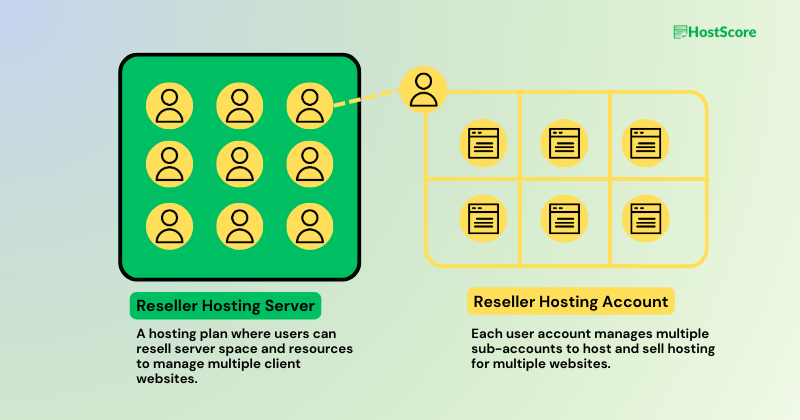
Reseller hosting lets you rent hosting resources from a provider and sell them under your own brand. The provider manages the servers, while you package and price the resources for your clients.
It works much like wholesale retail: you buy in bulk from the source, rebrand the product, and resell it at a markup to make a profit.
Reseller hosting is a good fit for web developers, digital agencies, or entrepreneurs who want to offer hosting services without the complexity of running physical infrastructure.
Reseller hosting can be suitable if you:
- Need hosting for your own sites and want to sell excess capacity to others.
- Want to create an extra income stream alongside your main business.
- Plan to grow into a full-scale hosting provider in the future.
Key Features to Look for in a Reseller Hosting Plan

When choosing reseller hosting, several key features are critical for ensuring smooth operations and a positive client experience. Here’s what to look for:
- White-Label Solutions White-labeling allows you to sell hosting services under your own brand without revealing the parent hosting provider. This is essential for building your business identity and presenting a professional service to your clients.
- Cost vs. Functionality Rather than focus on the price of the plans available on a host, make sure you assess price against features provided. There’s no point buying the cheapest if it won’t support what you want to do in your reseller business.
- Resource Allocation & Scalability A great reseller hosting plan should provide generous disk space, bandwidth, and the ability to create multiple client accounts. Look for hosts that allow for easy scaling as your business grows, ensuring you can add more resources without disrupting service.
- Ease of Management The availability of a user-friendly hosting control panel makes managing client accounts straightforward. A user-friendly interface is key to managing domains, emails, databases, and other hosting tasks efficiently.
- Control Panel Licensing As a reseller, you get a limited number of licenses you can share out among your customers. Make sure you assess the plans available and see if the licenses provided are enough to cover how you intend to partition out your plans.
- Billing & Automation Tools Integrated tools like WHMCS are invaluable for managing client billing, invoicing, and account automation. These tools make it easy to track payments, manage subscriptions, and provide an overall seamless experience for both you and your customers.
- Security Features Security is a top concern for clients, and your reseller hosting should include features like auto malware scan, regular server backups, offsite backup, and DDoS protection. Having built-in security tools minimizes the risk of attacks and gives your customers peace of mind.
- 24/7 Customer Support As a reseller, you’re the point of contact for your customers, but having access to 24/7 technical support from your hosting provider ensures you can resolve any issues promptly. Spend some time talking to your potential host and gauging their speed and knowledgeability before signing up for a reseller plan.
Reseller Hosting Pricing Models Explained
Reseller hosting pricing varies depending on how providers allocate resources and bill their resellers. The main models include:
1. Per-Account Pricing
In a per-account pricing model, the reseller hosting provider charges you a fixed monthly fee for each customer account you create. This means your costs are directly tied to the number of clients you host, making it straightforward to calculate profit margins.
For example: If a provider charges $5 per account and you resell hosting at $15 per account, you make a $10 margin per client before factoring in other business costs.
Pros:
- Easy to forecast expenses since each account has a set cost.
- Predictable billing makes it simpler to manage cash flow.
- Works well for resellers who target customers with similar hosting needs.
Cons:
- Less flexible if some clients need significantly more resources than others.
- May become expensive if you serve many small accounts.
2. Bulk Resource Allocation
In the bulk resource allocation model, the provider sells you a pool of server resources, which you divide among your customers. You decide how much each account gets, giving you more control over resource distribution.
For example: You might purchase 200GB of storage and 4TB of bandwidth for $50/month, then split it across 20 clients in a way that maximizes both performance and profit.
Pros:
- Flexible — you can allocate more resources to demanding clients without creating extra accounts.
- Potentially higher profit margins if your customers don’t use all their allocated resources.
- Works well for agencies hosting a mix of small and large websites.
Cons:
- Requires careful resource management to prevent overselling or performance issues.
- More monitoring and technical oversight compared to per-account pricing.
3. Commission-Based Reseller Programs
With commission-based reseller programs, you don’t directly manage hosting accounts. Instead, you refer customers to the hosting provider, who handles all billing, support, and technical operations. You earn a commission for each customer you bring in.
For example: If a hosting provider offers a 30% recurring commission and you refer a customer who pays $20/month, you’ll earn $6/month for as long as they remain a customer.
Pros:
- No need to handle technical support or server management.
- Low startup cost since you’re not renting server space.
- Can be combined with other affiliate marketing activities.
Cons:
- Limited control over branding — the hosting provider’s name remains visible to the customer.
- Commission rates vary and may be lower than direct reselling margins.
White-Label vs Managed Reseller Hosting: What’s the Difference?
White-label reseller hosting lets you fully rebrand the hosting service as your own. Your clients won’t see the original provider’s name, allowing you to control branding, pricing, and customer experience. This model suits agencies or businesses that want a complete hosting brand presence.
Managed reseller hosting offers more hands-off operation. The provider handles technical management, such as server updates, security patches, and performance monitoring; while you focus on client acquisition and support.
In short:
- White-label: Maximum control and branding, more technical responsibility.
- Managed: Less control over branding, but reduced operational workload.
Choosing between them depends on how much time, technical skill, and branding control you want in your reseller business.
Getting Started with Your Reseller Hosting Business
How to Choose the Right Reseller Hosting Provider (Step-by-Step)
Your hosting provider is the partner in your reseller hosting business. Choosing the right one involves careful consideration of your business goals and client needs. Here’s a simple step-by-step guide to help you make the right choice:
- Assess Your Client Needs Estimate how many client accounts you’ll need and what level of resources (disk space, bandwidth) each will require. This will help you choose a plan that can accommodate your current and future clients.
- Look for White-Label Solutions Ensure the host offers white-label features so you can fully customize the branding and maintain a professional appearance to your customers.
- Check for Billing & Management Tools Opt for a provider that includes automated billing and management tools like WHMCS.
- Consider Scalability Choose a plan that allows you to easily upgrade resources or add more client accounts as your business grows.
- Evaluate the Provider’s Support Make sure the provider offers 24/7 reseller-specific support so you can get help quickly in case of technical issues affecting your clients.
- Review Pricing & Renewal Costs Understand the full cost of the hosting plan, including any renewal fees, to avoid unexpected costs down the line. Choose a provider that offers competitive pricing while delivering the features you need.
Beyond Hosting: Tips for Growing a Profitable Reseller Hosting Business
Reseller hosting is more than just selling server space – it’s about delivering value to your customers and building a strong brand. For those who are new, below are some practical tips for running a successful reseller hosting business.
- Provide Excellent Customer Support Keeping customers happy is key. Use tools like Zendesk or Freshdesk to streamline your support system, manage tickets, and resolve issues quickly.
- Offer Additional Services Boost revenue by offering services like website design or maintenance. Use platforms like Fiverr Business or Upwork to find freelancers for tasks you can outsource to provide more value.
- Build a Strong Brand Use Canva to create professional branding materials, including your website design and social media graphics. Maintaining a consistent and professional image helps attract more clients.
- Monitor Resources & Scale Smartly Use tools like WHMCS to monitor client accounts, track resource usage, and handle automated billing. This ensures you can scale your hosting plans as your business grows.
- Market Your Services Effectively Leverage email marketing platforms like Mailchimp or ConvertKit to grow your client base and stay connected with existing customers. Offering referral programs or discounts through these tools can boost growth.
Final Thoughts
Running a reseller hosting business is very different from managing hosting for personal use.
Success depends on choosing a provider that offers white-label branding, easy scalability, reliable support, and pricing that leaves room for healthy profit margins.
Beyond picking the right host, you’ll need marketing skills to attract clients and technical know-how to manage accounts effectively. Reseller hosting is not a passive income stream — it requires ongoing time, effort, and financial investment.
If you’re serious about entering this space, start with a detailed business plan that factors in hosting costs, operational workload, market demand, and sales strategy. The hosting industry is highly competitive, so identify a clear value proposition to stand out and build a sustainable business.

